Skip to content
If you want to grow your online store, you need more than traffic. You need understanding.
Who is actually buying from you?
What does their daily life look like?
What problem does your product solve for them?
Why did they choose you instead of a competitor?
These questions are not optional. They sit at the center of every high-performing eCommerce strategy.
Buyer personas help you answer them with clarity. When built correctly, buyer personas improve your marketing, sharpen your messaging, guide your product development, and create alignment across your entire business.
They give your team a shared language for decision-making. Instead of debating what customers might want, you work from structured insight.
What Buyer Personas Are
A buyer persona is a fictional profile that represents a specific segment of your audience. It includes demographic details, behavioral patterns, motivations, goals, and frustrations.
But the key word is specific. If you sell coffee, your persona is not “coffee drinkers.” That category is too broad to influence execution.
A stronger persona might be busy entrepreneurs in their forties who want to brew high-quality coffee quickly before work and value consistency over experimentation.
That level of detail changes how you write product descriptions. It changes your photography. It changes how you structure bundles. It changes your email campaigns.
Personas also matter during periods of rapid market change. Consumer behavior shifts. Spending priorities move. Device usage patterns evolve. If you understand your core customers deeply, you can adapt faster.
Without personas, growth becomes reactive. With personas, growth becomes intentional.

Step 1: Gather Real Customer Information
Strong personas begin with data. Not assumptions.
The goal is to identify patterns that emerge from your actual customers. The more reliable your inputs, the more valuable your personas will be across marketing, merchandising, and product strategy.
You should collect insight across three dimensions:
- Demographics: Age range, income bracket, geographic location, household size, education level, occupation. These factors help you understand context and purchasing power.
- Psychographics: Attitudes, values, motivations, and interests. Do your customers prioritize convenience? Sustainability? Status? Simplicity? Psychographics reveal why people buy.
- Behavioral patterns: Order frequency, average order value, device preference, time to purchase, category affinity, engagement with reviews or educational content. Behavior reveals how customers move through your store.
The most effective persona work combines all three.
Where to Collect This Information
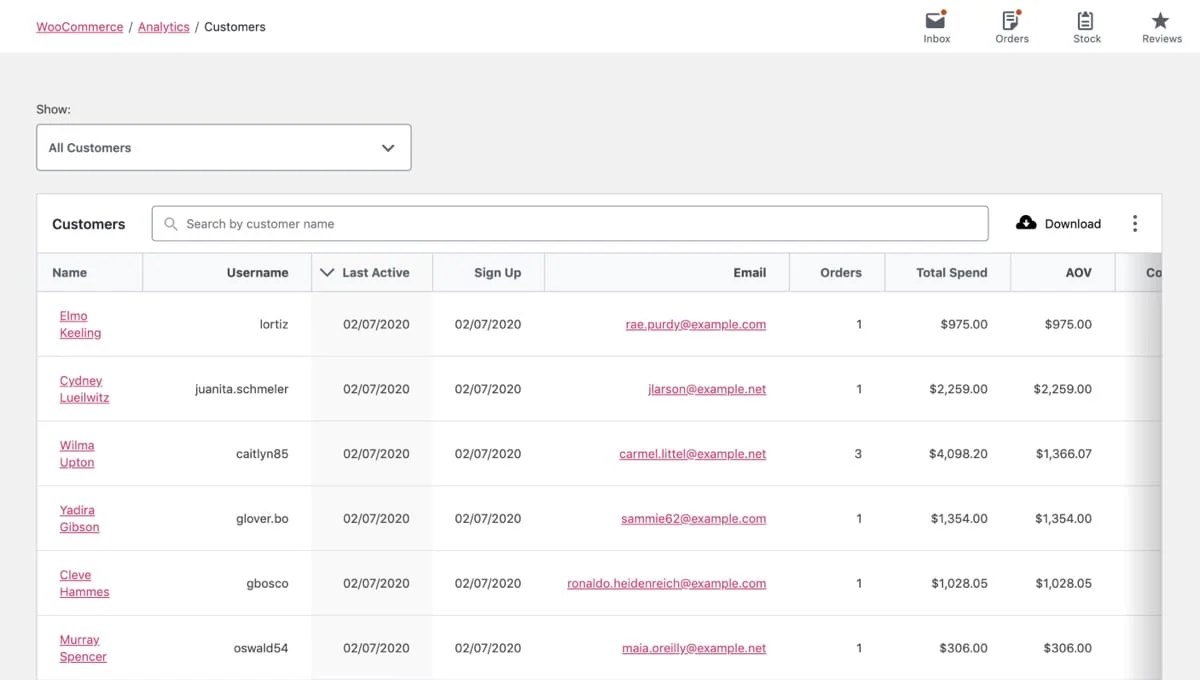
Start with your existing WooCommerce data. Your customer reports already consolidate repeat orders by email address, giving you visibility into lifetime value and purchasing patterns.
- Sort customers by total spend.
- Identify repeat buyers.
- Look at geographic clusters.
- Compare mobile and desktop conversion behavior.
If you notice that your highest lifetime value customers consistently purchase from specific regions or primarily shop on mobile, that insight should influence how you design your store. Then go further:
- Add optional fields to checkout to gather relevant purchase context. For example, are they buying for themselves or as a gift? Are they shopping for a child of a specific age? Keep questions simple and relevant to avoid friction.
- Send surveys to existing customers. Open-ended questions often reveal insights you did not think to ask. Tools like Crowdsignal make it easy to gather structured responses while also collecting qualitative feedback.
- Social media also offers valuable input. Polls and direct questions can surface early signals about preferences and frustrations. Monitor how your audience talks about your product category.
Finally, speak directly with customers when possible. Structured interviews can uncover decision-making patterns that analytics alone cannot explain.

Step 2: Identify Common Characteristics
Once you gather data, the next step is pattern recognition.
Look at your most profitable and loyal customers. What do they share?
- Do high-value customers tend to enter through Instagram but convert on desktop?
- Do certain age groups respond more to bundles than individual products?
- Are repeat buyers more likely to purchase without discounts?
Separate demographic similarities from behavioral similarities. Both matter, but behavior often drives strategy.
For example, you might discover that customers in urban areas respond strongly to fast shipping options and early-access promotions.
Or you may find that customers aged 30 to 34 with higher household income gravitate toward curated sets instead of single products.
Layer qualitative insight on top of these patterns. Suppose your analytics show that a large segment of customers aged 28 to 35 consistently buys one product per order, even after browsing multiple categories.
Survey responses reveal that they hesitate to spend too much until they know the product works for them.
Now you understand the underlying driver is trust. That insight might lead you to introduce trial sizes, highlight guarantees more prominently, or showcase testimonials more aggressively.
This is where persona development moves from data collection to strategic advantage.
Step 3: Identify Goals and Pain Points
A persona without goals and pain points is incomplete.
Your customers are trying to accomplish something. They are also encountering friction.
Goals often appear as aspirations:
- “I want something simple.”
- “I need to save time.”
- “I want to feel confident in my choice.”
Pain points appear as obstacles:
- “There are too many options.”
- “I don’t know which bundle makes sense.”
- “I worry about late delivery.”
Map these across stages of the customer journey. Before purchase, customers may struggle with comparison or information overload.
During checkout, they may hesitate due to unclear shipping policies. After purchase, they may feel uncertain about how to use the product effectively.
For example, a home goods brand might identify a goal such as furnishing a new apartment without decision fatigue.
The paired pain point might be confusion about dimensions and delivery timelines. Together, these insights inform product page clarity, photography, FAQ structure, and follow-up emails.
When personas include both goals and friction, they guide execution across marketing, UX, and support.
Step 4: Segment Into Distinct Personas
Now you can group shared characteristics, motivations, and behaviors into structured profiles.
The number of personas should reflect your product complexity and audience diversity. Most growing stores operate effectively with two to four clearly defined personas. The goal is clarity, not volume.
For example, you might identify one segment that values speed and simplicity. They shop on mobile, make fast decisions, and prioritize frictionless checkout. Another segment may be research-driven.
They compare options, read reviews, revisit multiple times, and need detailed information before committing.
You may also uncover a promotion-sensitive group that responds strongly to bundles and discounts, or a premium-focused group that prioritizes quality signals over price.
These profiles should be grounded in measurable behavior and validated motivation. When defined properly, they directly shape landing pages, product presentation, messaging, and ad strategy.
Personas answer a critical question: who are you optimizing for?

Making Buyer Personas Part of Your Growth Engine
Buyer personas should not sit in a presentation folder. If they are not shaping decisions, they are wasted effort.
As your store grows, customer behavior shifts. New traffic sources emerge. Product lines expand. Purchase cycles change. If your personas stay frozen while your data evolves, they quickly lose value.
Review them quarterly. Compare current behavior against your original assumptions.
Are your highest lifetime value customers still coming from the same channels? Has mobile overtaken desktop? Are certain segments becoming less price-sensitive?
Even subtle shifts should influence strategy. Personas also need to move beyond marketing.
Campaign briefs should reference specific personas and their motivations. Product teams should prioritize roadmap decisions based on documented friction points.
Support teams should understand the emotional drivers behind purchases so responses feel relevant, not generic.
Building a Store Around Real Customers
Personas provide clarity.
If you run your store on WooCommerce, you have the flexibility to customize checkout flows, personalize product recommendations, optimize performance, and integrate advanced reporting.
But customization without insight leads to unnecessary complexity.
At CoSpark, we work with growth-focused WooCommerce brands to translate customer insight into high-performance store architecture.
From conversion optimization and performance tuning to custom WooCommerce development services and enterprise-level support, we help you align your store with the real behavior of your best customers.
If you want to build an eCommerce experience that reflects how your audience actually thinks and shops, let’s talk. Your growth should not rely on guesswork. It should be built on understanding.