Skip to content
There’s a fair amount of noise around “agentic commerce” right now. Some of it is real, some of it is the usual AI hype cycle, and most store owners haven’t had time to sort out which is which.
Honest answer up front: it’s both. There’s hype, and there’s also a genuine shift happening underneath it that most store owners haven’t clocked yet.
On December 11, 2025, Stripe launched its Agentic Commerce Suite. WooCommerce was one of the launch partners.
Most store owners missed the announcement entirely, and the ones who saw it mostly filed it under “future of ecommerce” and moved on.
That’s a mistake, because it quietly set the stage for one of the biggest shifts in how customers will find and buy from online stores over the next few years.
Here’s the shift in one sentence: customers are starting to delegate their shopping to AI assistants, and those assistants are starting to buy on their behalf.
If you run a WooCommerce store, that has real consequences.
It changes how your products get discovered, how your checkout flow works, and even whether your analytics keep working the way they do today.
This post walks through what’s actually happening, what’s hype, and what you should do about it.
What Is Agentic Commerce?
Agentic commerce is shopping where an AI agent (ChatGPT, Google Gemini, Perplexity, or others) does the work on behalf of a human buyer.
The shopper says what they want. The agent searches, compares, and in many cases completes the purchase.
It’s a meaningful break from how ecommerce has worked for the last two decades. Traditional ecommerce is destination-based: the customer comes to your store.
Agentic commerce is intent-based: the customer states what they want, and the AI handles everything in between.
McKinsey describes the shift as commerce moving from discrete human steps into “a continuous, intent-driven flow powered by autonomous AI systems.” Their numbers:
- Up to $1 trillion in US B2C retail revenue mediated by AI agents by 2030
- $3 trillion to $5 trillion globally by the same year
These aren’t speculative figures pulled out of thin air. They’re based on adoption curves that are already showing up in real data.
Worth a small caveat though: every analyst firm in the world is currently producing a “trillion dollars by 2030” report on something AI-related.
Take the exact number with a pinch of salt. The direction of the curve is the part that matters, and the direction is unambiguous.

How Is Agentic Commerce Different From Normal Online Shopping?
Easiest way to see it is side by side:
| Traditional Ecommerce | Agentic Commerce |
| Customer searches Google | AI agent searches on behalf of the customer |
| Customer visits your store | AI agent queries your product catalog directly |
| Customer reads descriptions and reviews | Agent parses structured product data |
| Customer clicks through checkout | Agent completes the transaction autonomously |
| Store captures the visit via browser analytics | No browser session, so standard tracking doesn’t fire |
That last row is where most store owners get blindsided. We’ll come back to it.
The buying journey doesn’t disappear in the agentic model. It just moves.
Decisions that used to happen on your product page now happen inside an AI assistant, often before your store is ever visited.
Why WooCommerce Merchants Need to Pay Attention Right Now
A lot of “future of ecommerce” posts age badly.
This one shouldn’t, because the foundations are already in place and WooCommerce is directly part of them.
WooCommerce and Stripe: What Was Announced in December 2025
Stripe’s Agentic Commerce Suite is a platform that lets businesses sell through multiple AI agents using a single integration. WooCommerce was named a launch partner from day one.
In plain terms:
- WooCommerce powers over 4 million live online stores globally (StoreLeads, 2026). All of them are positioned to receive AI-agent orders as the rollout expands.
- Merchants using Stripe for WooCommerce will be among the first to access the integration.
- Instead of building a separate connection for each AI assistant, you connect your catalog once. Stripe handles discovery, checkout, payments, and fraud protection across all supported agents.
WooCommerce’s own announcement called it “a significant moment for WooCommerce merchants.”
One important caveat: the Agentic Commerce Suite is still rolling out.
Not every WooCommerce store is live with agent orders today.
But the path is defined, the protocol is open, and the time to prepare is right now, before agent orders start landing in volume.

WooCommerce MCP: The Other Piece of the Puzzle
Alongside the Stripe partnership, WooCommerce added native support for the Model Context Protocol (MCP) in version 10.3, released October 21, 2025.
MCP is an open standard originally developed by Anthropic.
It lets AI assistants connect directly with external tools and data.
In WooCommerce’s case, that means AI assistants like Claude can interact with your store directly.
They can search products, manage orders, and access catalog data through a standardized interface.
The WooCommerce developer blog describes the longer-term goal as MCP “expanding beyond store management and potentially powering consumer shopping and checkout, also known as agentic commerce.”
One technical note worth flagging: WooCommerce MCP is currently in developer preview.
Implementation details may change as the feature matures, so anything you build on it today should be designed with that in mind.
How Do AI Agents Actually Shop? A Step-by-Step Breakdown
The mechanics help you see where your store needs to be ready.
Here’s how an agentic purchase moves through the system:
Step 1. Intent. Shopper tells the AI what they want.
Could be “reorder my usual coffee beans” or “find me a standing desk under $500 with next-day delivery.”
Step 2. Discovery. The agent queries product catalogs using the Agentic Commerce Protocol (ACP), an open standard co-developed by Stripe and OpenAI, released under the Apache 2.0 license in September 2025.
Your store has to be reachable via this protocol to even show up.
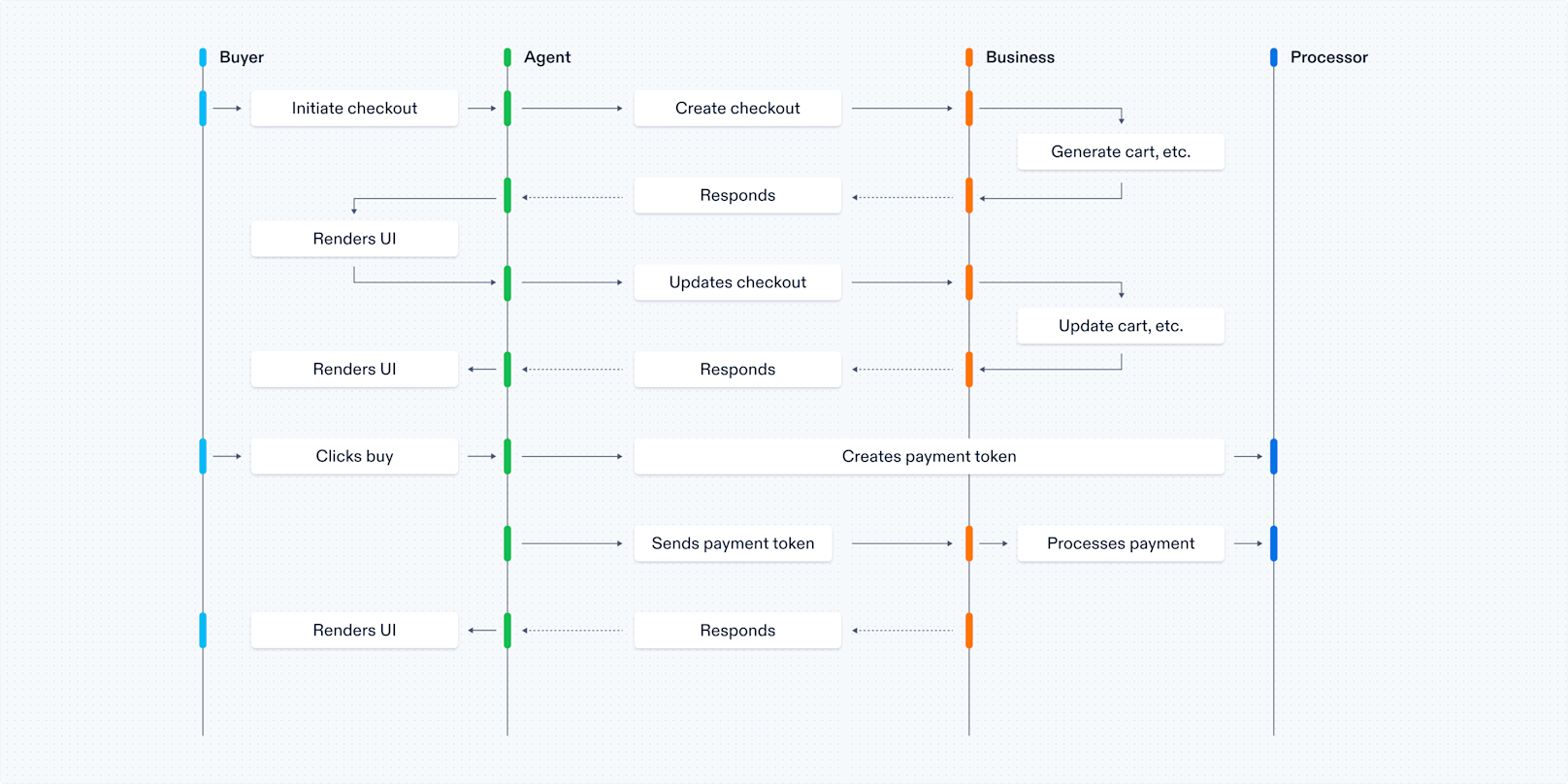
Step 3. Evaluation. The agent reads your product data (title, description, price, availability, variants, shipping options) and matches it against the shopper’s requirements.
Thin or incomplete data gets skipped.
Step 4. Transaction. If your product matches, the agent initiates checkout using a Shared Payment Token.
That’s a secure, single-use credential that processes payment without exposing the buyer’s card details. No browser opens. No “add to cart” gets clicked.
Step 5. Fulfillment. The order shows up in your WooCommerce dashboard. Your existing order management takes over from there.
The whole process can happen without a customer ever loading your site. That’s the opportunity. It’s also the problem.
The Three Biggest Implications for Your WooCommerce Store
Of these three, the tracking one is the genuinely urgent one. The other two matter, but you have a few months. The tracking issue is the one that’s already silently breaking on stores that don’t know it yet.
1. Product Data Quality Becomes Your Most Important Asset
AI agents can’t guess what your products are. They read structured data (attributes, variants, specifications, pricing rules, availability signals).
If your titles are vague, your descriptions thin, or your attributes half-filled in, the agent will skip your products and recommend a competitor whose catalog is cleaner.
This is a real shift in how to think about product pages.
For years, the focus has been writing for human readers, with compelling copy, lifestyle imagery, social proof.
In the agentic model, you’re also writing for machine readers that need precision, not persuasion.
What that looks like in practice:
- Product titles need to be specific, not generic. Not “Blue Shirt”, but something more like “Men’s Slim-Fit Oxford Shirt, Blue, 100% Cotton”.
- Attributes need to be filled in completely: size, weight, material, compatibility, dimensions.
- Pricing has to be accurate and current. Agents check this in real time.
- Stock signals need to be reliable. An “in stock” product that turns out to be sold out creates a failed agent transaction, and that hurts your standing with the agent.
If your store has years of inconsistent product data behind it, this is the area that’ll need the most work before agent orders start arriving.
For a wider look at how product page quality affects conversions, our WooCommerce conversion optimization guide covers the human side of the same problem.
2. Traditional Traffic Tracking Breaks Down
This is the implication most store owners don’t see coming, and technically it’s the most consequential.
Every analytics tool you use today was built for human browser sessions.
When a customer visits your store, a browser opens, JavaScript fires, cookies get set, and your GA4, Meta Pixel, and Google Ads tags all record the visit and the purchase.
When an AI agent places an order, none of that happens. The order shows up in your dashboard the next morning, you fulfil it, you ship it.
You never know that the entire transaction happened while you were asleep, on a device that wasn’t a browser, through a flow that never touched your conversion tags.
If you’ve ever dealt with GA4 attribution gaps before, the implications here will already be obvious.
What Breaks Specifically
- Google Analytics 4. No browser session means no gtag JavaScript fires. The purchase event never gets sent. The order exists in WooCommerce and Stripe, but nowhere in your analytics.
- Meta CAPI. With no browser session and no real user interaction signal, event match quality drops close to zero.
- Google Ads conversion tracking. No click, no impression, no gclid. Smart Bidding gets no signal for the conversion.
- Your thank-you page tags. If your store fires conversion tags only on the WooCommerce order confirmation page, and the agent never loads that page in a browser, none of those tags fire.
The result is that clean agent orders become invisible to every ad platform you optimize against.
As agent-driven orders grow (and they will), your attribution data gets quietly more inaccurate without you realizing.
Fixing this means server-side tracking that captures order events at the WooCommerce and Stripe level, not at the browser level. It’s a development task, not a plugin install.
If you’d like context on why technical infrastructure matters to your store’s revenue more broadly, our post on why your WooCommerce site might be slow covers related ground.
3. Discovery Rules Are Being Rewritten
Today, being found online basically means ranking on Google. You invest in SEO, content, and backlinks so that when someone searches for what you sell, your store appears.
In the agentic model, the first “customer” in your funnel might not be a human at all. It might be an AI agent checking whether your products fit a buyer’s intent.
The numbers already show this shift. TechCrunch reported that AI-attributed orders on Shopify grew 11x between January 2025 and early 2026. Adobe Analytics reported AI-driven traffic to US retail sites was up 393% year-over-year in Q1 2026, with March alone up 269% YoY.
The conversion data is the more striking part. By March 2026, AI-referred traffic was converting 42% better than non-AI sources like paid search and email.
That’s a complete reversal from March 2025, when AI traffic was converting 38% worse. These shoppers arrive with sharper, pre-filtered intent.
The stores that win in this environment won’t necessarily be the biggest ones.
They’ll be the ones with the cleanest data, the most complete product information, and the technical infrastructure to be discovered and transacted with by agents.
This connects directly to the WooCommerce vs Shopify debate.
As we covered in our WooCommerce vs Shopify scalability comparison, WooCommerce’s open-source foundation gives you direct control over your data structures, API endpoints, and integration stack.
In an agentic world that rewards flexibility and extensibility, that’s a real advantage.

Frequently Asked Questions
What is agentic commerce in simple terms?
Agentic commerce is when an AI assistant shops on your behalf. Instead of visiting a website, browsing, and checking out yourself, you tell the AI what you want and it handles the whole process (searching, comparing, and buying) on its own.
For store owners, the practical meaning is that your products need to be discoverable and purchasable by AI systems, not just by human visitors.
Does agentic commerce work with WooCommerce?
Yes. WooCommerce was named a launch partner for Stripe’s Agentic Commerce Suite in December 2025. That integration lets WooCommerce merchants using Stripe make their catalogs discoverable through AI agents like ChatGPT.
WooCommerce has also added native MCP (Model Context Protocol) support, which lets AI assistants interact with your store directly. Both features are in active rollout through 2026.
What is the Agentic Commerce Protocol (ACP)?
ACP is an open standard co-developed by Stripe and OpenAI. It defines how AI agents, merchants, and payment providers communicate during a transaction.
It was released under the Apache 2.0 licence in September 2025 and is currently in beta. The point of ACP is that merchants implement it once and become reachable through any ACP-compatible AI agent, instead of building a separate integration for each one. More detail at agenticcommerce.dev.
What is the difference between ACP and MCP?
They do different things and work together, not against each other.
MCP (Model Context Protocol), developed by Anthropic, is the layer that lets AI assistants access and manage your store’s data in real time. Think of it as the AI’s ability to read and interact with your store.
ACP (Agentic Commerce Protocol), developed by Stripe and OpenAI, is the layer that lets AI agents complete transactions on behalf of buyers.
Think of it as the checkout and payment standard for agent-driven orders.
Most WooCommerce stores preparing for agentic commerce will need both eventually.
Do I need to rebuild my WooCommerce store for agentic commerce?
Not necessarily rebuild, but you’ll likely need to improve in specific areas.
The main requirements are clean, complete product data, reliable real-time inventory signals, server-side tracking infrastructure, and compatibility with Stripe’s Agentic Commerce Suite.
If your store has a well-maintained technical foundation, the path to agentic readiness is manageable without starting from scratch.
If your store has years of accumulated technical debt (messy product data, slow performance, plugin conflicts), it’ll likely take more work. A proper audit is the right first step.
When will AI agents actually start buying from WooCommerce stores?
It’s already started. The infrastructure is live. Stripe’s Agentic Commerce Suite launched in December 2025 with WooCommerce as a partner. That said, full autonomous purchasing at scale is still early.
The bigger reality through 2026 is that AI agents are already driving significant discovery, sending high-intent traffic to stores as buyers research and decide via AI assistants.
The transaction side is following close behind. Stores that prepare their data and tracking infrastructure now will be in a stronger position once agent-driven orders become a meaningful share of revenue.
How to Start Preparing Your WooCommerce Store for Agentic Commerce
No need to panic, but don’t sit on it either. Here’s a practical starting framework:
Audit your product data first. Go through your catalog and ask: does an AI agent have everything it needs to confidently recommend and sell this product?
Complete titles, accurate attributes, current pricing, reliable availability. This is foundational, and you can start on it today.
Check your Stripe integration. If you’re already on Stripe for WooCommerce, you’re on the right platform for agentic commerce access.
Make sure your integration is on the current version of the official Stripe for WooCommerce extension.
Plan for server-side tracking. Most stores will need development help here. If agent orders are invisible to your analytics and ad platforms, your optimization decisions get less reliable over time.
Getting server-side tracking in place before agent orders arrive is significantly easier than retrofitting it afterwards.
Don’t rush a DIY rebuild. The stores that handle agentic commerce well are the ones with clean, well-architected technical foundations.
Rushing to add plugins or restructure things without a clear plan tends to create the kind of technical debt that causes problems later.
If you’re unsure where your store currently stands, our WooCommerce development team can run a technical audit and lay out what needs to change, in what order.
Agentic commerce isn’t arriving the way most technology shifts do, with a clear launch date and a moment where everything changes overnight.
It’s arriving the way the mobile web did: gradually, then faster than anyone expected.
The store owners who’ll benefit most are the ones who saw it coming before it became unavoidable.
The good news is, the work to prepare is mostly work you’d want to do anyway: clean data, solid infrastructure, accurate tracking.
None of it is wasted, even if your first AI-agent order is still six months away.
If you have questions about where your store stands or what to prioritise, that’s exactly the kind of conversation our team is set up to have.